
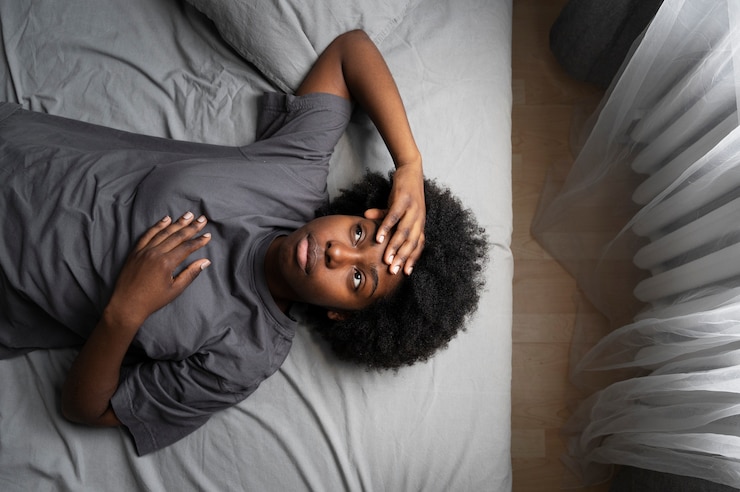
You know that feeling when you’re lying in bed, staring at the ceiling, wondering why
your brain has decided that 11 PM is the perfect time to replay your day on loop? Or
suddenly waking up and picturing all the things that could go wrong with your
presentation next week? Your bedroom has blackout curtains, is the perfect
temperature, and a mattress that blew your budget. You even have a sleep app, so why
are you still struggling to get a good night’s rest?
You’re definitely not alone. Studies show that 14.5% of adults struggle to fall asleep
most nights, and 17.8% wake up frequently during the night.¹ That’s millions of people
battling broken sleep. But while we're all Googling 'how to fall asleep faster' at 1 AM,
turns out the answer isn't in another sleep hack or expensive gadget. What if the
solution is as simple as a getaway in nature? According to a growing body of research,
nature-based holidays may be the most effective (and enjoyable) sleep remedy.
Samantha Pillay, Director at ekko, a leading lifestyle brand for millennials, shares that
like many, she has arrived at a holiday destination before, stressed, overstimulated, and
sleep-deprived. “Yet, after just a few days, I’m sleeping deeply, waking up refreshed,
and wishing I could extend my stay,” she says. “There’s something incredibly restorative
about escaping to nature. From soft ocean breezes to forest walks and crisp mountain
air away from the crowds, the benefits go far beyond fresh air and pretty views.”
Here's five reasons why you sleep better when you holiday in nature and why it’s
worth booking that escape:
1. Your body clock resets.
Natural light exposure (especially in the morning) helps regulate your circadian
rhythm, the internal clock that tells your body when to sleep and wake. A 2013 study
in Current Biology found that just a few days of increased daylight exposure can shift
this rhythm into better sync with the natural day-night cycle.²
2. Stress melts away.
Nature lowers cortisol levels, the hormone associated with stress and poor sleep. A
meta-analysis published in Environmental Research confirmed that time in natural
environments reduces stress, lowers blood pressure, and promotes relaxation — all
vital for falling and staying asleep³
3. Activity improves sleep.
Whether it’s walking trails, paddling in a river or dam, horseback riding, or simply
exploring, holidays in nature naturally involve more physical activity. The Sleep
Foundation confirms that moderate movement during the day helps people fall asleep
faster and enjoy deeper sleep cycles.⁴
4. You disconnect – properly.
The absence of constant digital noise, artificial light, and city traffic helps your
nervous system settle. A quieter environment without screens before bed supports
melatonin production, which is key to falling asleep.⁵
5. It’s Not Just Sleep – It’s Wellness
Time spent in green and blue spaces—like forests, lakes, and oceans—has been
linked to improved mood, reduced anxiety, and sharper cognitive function. Research
in Environmental Health Perspectives shows that greater exposure to nature
strengthens resilience and boosts overall wellbeing, helping you return from your
holiday feeling mentally refreshed.⁶
Whether you fancy a mountain escape in the Drakensberg, a beach retreat in Thailand,
or walks in the Black Forest in Germany, this is when owning an ekko portfolio really
pays off. Enjoy discounted luxury travel with access to an extensive range of local and
international hotels and resorts, cruises, flight deals, car hire and even tours. Use your
shares to book holidays at more than 50 top-tier South African resorts in prime locations
or choose from over 10,000 additional SA hotels and resorts at up to 50% off, plus more
than 500,000 luxury options worldwide. Ekko offers you access to countless local and
international destinations, perfect for connecting with nature.
“The fact is that so often we don’t realise how much our bodies need a reset. So if
you’re always struggling to sleep, don’t reach for a sleeping pill, reach for your suitcase
and head for the horizon,” Pillay concludes. “A break in nature might be exactly what
your body has been asking for.”
ENDS
WORD COUNT: 686
Sources:
1. https://www.cdc.gov/nchs/products/databriefs/db436.htm?utm_source=chatgpt.com
2. Wright, K.P. Jr. et al. (2017). Entrainment of the human circadian clock to the natural light-dark cycle. Current Biology,
23(16), 1554–1558.
3. Twohig-Bennett, C. & Jones, A. (2018). The health benefits of the great outdoors: A systematic review and meta-
analysis of greenspace exposure and health outcomes. Environmental Research, 166, 628–637.
4. Sleep and Exercise. Sleep Foundation. (Updated 2022). https://www.sleepfoundation.org
5. Harvard Health Publishing. (2020). Blue light has a dark side. Harvard Medical School. https://www.health.harvard.edu
6. Environmental Health Perspectives, 2019. “Associations of Residential Greenness with Mental Health: A Systematic
Review”
On Behalf of:
Samantha Pillay
Director: ekko